

Key Takeaways
- Birth trauma includes visible injuries, such as a broken collarbone or nerve injury, and subtler nervous system strain that standard imaging doesn’t show. Either can follow a routine delivery.
- Feeding trouble, head tilt, colic, uneven movement, and poor sleep all have many possible causes. A pattern of several signs matters more than any single one.
- Research on long-term effects of subtle nervous system strain is still limited, which is why early questions for your pediatrician and care team are worth asking.
- A pediatric chiropractor can assess your baby with INSiGHT scans (HRV, surface EMG, and rolling thermography) and gentle tonal adjustments, alongside your pediatrician.
- Lactation, occupational, speech, and physical therapy can work together with chiropractic care.
Signs of birth trauma in babies are easy to miss because many of them look like ordinary newborn behavior. Feeding struggles, long crying spells, and trouble settling can all be part of a normal first few weeks. They can also be signs of nervous system dysregulation, a state where your baby’s nervous system is still working through the stress of birth. This guide covers what birth trauma means, what to watch for, and how to decide your next step with your pediatrician and care team.
What is Birth Trauma in Babies?
Birth trauma means physical injury or neurological stress that happens to a baby during labor and delivery. It helps to think of two categories. The first is structural birth injury, such as a broken collarbone, nerve damage, or bruising of the scalp. The second is nervous system strain, which chiropractors who focus on neurology look for even when imaging shows nothing unusual. That second category is a chiropractic concept rather than a standard medical diagnosis, and research on it is still growing.
Either type can follow a routine delivery. A cord wrapped a little too tightly, a brief vacuum assist, a cesarean everyone called routine, or a labor so fast the team barely made it into the room can all be stressful for a baby. Just as nerve irritation after a car accident doesn’t always show up on an X-ray, the strain of birth may not appear on a scan.
The birth canal places real force on a baby’s head, neck, and spine, which are very delicate in the first moments of life. Even a manageable delivery involves compression and rotation.
How common are birth injuries? According to Medscape, recognized injuries from the mechanical forces of birth average about 6–8 per 1,000 live births. That number counts physical injuries only. It doesn’t capture subtler nervous system strain, and estimates vary by hospital and by how injuries are counted. If you’re unsure which kind of birth trauma your baby may have had, your pediatrician is the right place to start.
How Birth Trauma Happens: Causes During Delivery
Birth trauma is largely a mechanical story. During delivery, forces act on a baby’s head, neck, and upper spine. A newborn’s neck is still developing, yet it has to handle the pressure of moving through the birth canal, being guided by a provider’s hands, or being assisted by instruments.
Doctors can’t easily measure how much force a baby’s neck feels in a real delivery, and published measurements are limited. Even routine births involve compression, rotation, and sometimes pulling.
Birth trauma also rarely has one cause. Several factors can stack up, which PX Docs calls the Perfect Storm: fertility challenges or a high-risk pregnancy, stress during pregnancy, complications in labor, medical interventions, and feeling unsupported or unheard by the care team.
Factors that can add physical stress during birth include:
- Labor that runs unusually long
- A very fast (precipitous) labor, often defined as under 3 hours
- Forceps or vacuum assistance, which applies force to the baby’s head and neck
- A cesarean, now about one in three U.S. births, which can still involve force on the head and neck, especially when urgent
- A large baby, such as a birth weight over 4,000 grams (about 8 pounds 13 ounces), or one who is large relative to the mother’s pelvis
- Breech or posterior positioning, which requires more complex movements through the birth canal
- An umbilical cord wrapped around the baby’s neck (nuchal cord)
- Forceful hands-on assistance, such as pulling or twisting the baby’s head
None of these situations means someone made a mistake, and none of it is your fault. Many are unavoidable, and plenty of babies move through them without lasting difficulty. Understanding the cause isn’t about blame. It’s about knowing whether your baby’s birth history is worth mentioning to your care team.
Birth can be hard on mothers too. If you’re carrying a difficult birth story, you aren’t alone, and it’s worth telling your own provider how you’re feeling.
Signs of Birth Trauma Parents Often Miss

The signs of birth trauma are often hiding in plain sight. Many get brushed off as “just how newborns are.” Looking at them together can change the picture.
Signs tend to show up in clusters, so it helps to write down what you notice and when. A baby with feeding difficulty, a head tilt, sleep trouble, and digestive issues may be showing a pattern worth raising with your pediatrician. Each sign has other common causes, so a pattern is a reason to ask questions, not proof of trauma.
Here’s what to watch for.
Physical Signs in a Newborn’s Body and Movements
These are some of the most visible signs:
- Head tilt or rotation preference: the baby consistently turns their head to one side and resists turning the other way (a sign of torticollis)
- Asymmetrical limb movement: one arm or leg moves noticeably differently from the other, or one limb hardly moves at all (a limp arm needs a prompt pediatric exam; see the action guide below)
- Back arching: the baby frequently arches away from caregivers, especially during feeding or while lying down
- Flat spots on the head: positional plagiocephaly developing on one side because the baby always rests in the same position
- Feeding difficulties: poor latch, preference for nursing on one side only, clicking sounds while nursing, or difficulty sustaining a suck
- Fussiness during tummy time: discomfort or protest that seems out of proportion to the position
Behavioral Signs That the Nervous System May Be Under Stress
These patterns are easier to chalk up to temperament, which is exactly why they’re missed:
- Excessive or inconsolable crying that doesn’t respond to typical soothing
- Difficulty self-soothing or calming between states
- Sensory sensitivity, startling easily, disliking certain holding positions, or reacting to ordinary sounds and touch
- Poor sleep or difficulty moving between sleep cycles
- A strong startle (Moro) reflex that lingers past the first several months
- Digestive issues including reflux, constipation, or gassiness
Any of these can be ordinary newborn behavior. When several show up together, or they don’t ease with time, they deserve a closer look.
Can Birth Trauma Affect a Baby’s Long-Term Development?
It’s possible, and the answer depends on the type of birth trauma. Serious structural injuries can affect development, which is why they need prompt medical care. For subtler nervous system strain, many chiropractors believe it may play a role too, but research is still limited.
The nervous system is the foundation for motor development, feeding, sleep regulation, and sensory processing. All of these depend on how well it’s working.
Areas families often ask about include:
- Motor milestones (rolling, sitting, crawling, walking)
- Feeding challenges that affect weight gain in the early months
- Early regulation struggles such as colic, a topic covered in our guide to natural colic relief
- Sensory processing, which can affect sleep, eating, and social engagement
Lasting effects aren’t inevitable, and many babies who have a stressful birth do well. Some effects may not show up until weeks, months, or even years later, when a milestone is missed or a child struggles to settle. If your child is older, birth history is still worth raising with your care team.
Whether early nervous system strain connects to later sensory or focus challenges is still being studied. What early attention gives you is time: to ask questions, to track milestones, and to get support in place while your baby’s brain is developing quickly.
The Nervous System Connection Behind Newborn Symptoms
Standard pediatric care focuses on growth, feeding, reflexes, and milestones, and it is essential. Chiropractors who focus on neurology look at one more piece: the brainstem.
The brainstem helps regulate automatic functions such as breathing, heart rate, and swallowing. It sits at the base of the skull and continues into the spinal cord, near the upper neck, an area that experiences force during delivery.
In chiropractic terms, tension or restriction in the upper neck is called subluxation, and chiropractors describe it as possible interference with nerve communication. This is a chiropractic concept, not a medical diagnosis, and a routine pediatric exam isn’t designed to test for it.
The vagus nerve is one nerve chiropractors watch closely. It runs from the brainstem through the neck, chest, and abdomen and helps guide digestion and calm. Chiropractors suggest that strain in the upper neck may affect it, which could show up as reflux, constipation, sensory sensitivity, or trouble self-soothing. Because each of those has other common causes, your pediatrician should always be your first call.
Chiropractors often describe the result as a nervous system stuck in “gas pedal” mode (the sympathetic side), with the brake (the parasympathetic side) hard to reach. Your baby isn’t giving you a hard time. Your baby may be having a hard time.
How a Baby Chiropractor Can Help After Birth Trauma
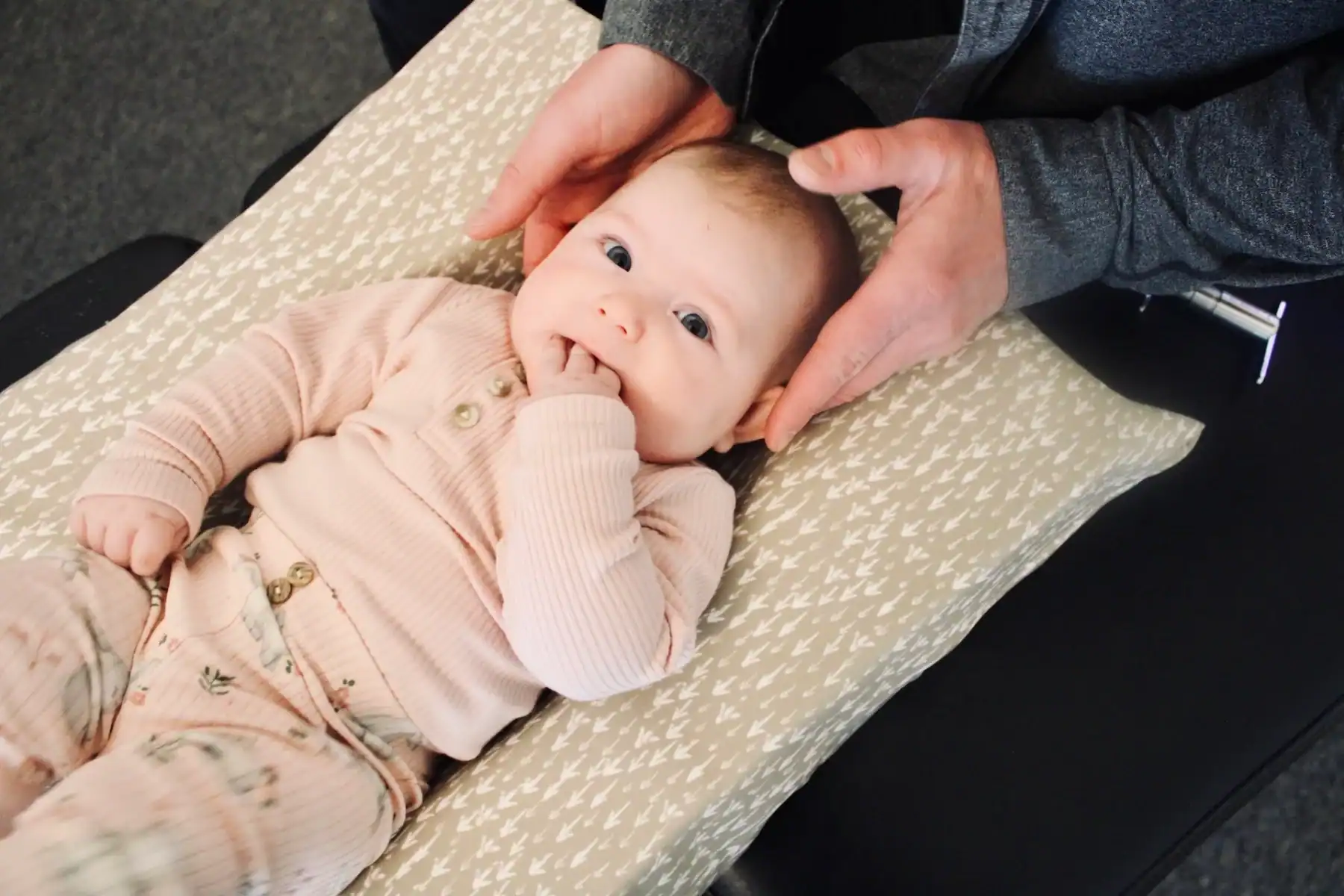
Many parents wonder whether a chiropractor can help a newborn. The answer starts with what pediatric chiropractic care involves.
Neurologically focused chiropractic care is drug-free and gentle enough for a newborn. Infant adjustments use very light fingertip pressure, about what you’d use to test whether a tomato is ripe. They look nothing like an adult adjustment.
At Adjusted Living Chiropractic, we call them gentle tonal adjustments. A baby chiropractor after birth assesses spinal alignment, range of motion in the neck and head, and tension patterns, then applies light, specific input to support the nervous system as it releases tension. You can learn more in our guide to baby chiropractor benefits after birth.
At Adjusted Living, care starts with INSiGHT scans, three non-invasive assessments that give a baseline and let us track change over time: heart rate variability (HRV), surface EMG, and rolling thermography. HRV shows how well the nervous system adapts to stress and how much adaptive reserve it has left. Surface EMG reads electrical activity in the muscles along the spine. Rolling thermography reads temperature differences down each side of the spine. Together, they measure function, which a standard exam isn’t designed to do. The scans are a starting point for care, not a diagnosis.
Every care plan is individualized, with no one-size-fits-all protocol. Dr. Ryan Angelo is certified through PX Docs, and Adjusted Living is the only PX Docs-certified pediatric chiropractic office in Chesterton and Porter County, Indiana. That training is built around neurologically complex and sensitive children, which shapes how every baby is evaluated here. Dr. Ryan has more than seven years of experience in this care.
Here’s what to expect. The first visit begins with a conversation about your baby’s birth history, current symptoms, and developmental milestones, followed by the INSiGHT scans. Dr. Ryan then builds a personalized care plan from the results and reviews it with you at a Report of Findings visit. Adjustments begin from there. Many babies stay relaxed through an adjustment.
Every baby is different, so there is no set timeline. Parents often track movement, feeding, digestion, and sleep, and follow-up scans show how your baby is responding. Dr. Ryan sets the plan’s frequency and length based on your baby’s history and scans, and adjusts it as your baby changes.
Other Support Options for Birth Trauma
Chiropractic care is one option among several. It works best as part of a team that includes your pediatrician and, when needed, other specialists. Your pediatrician can refer you to any of these. Here are five types of support worth knowing about:
- Craniosacral therapy: a gentle hands-on approach focused on the membranes and fluid around the brain and spinal cord. Some families explore it after a stressful birth, but research on it is limited, so talk with your pediatrician first.
- Occupational therapy: supports sensory processing and feeding challenges, including babies who are hypersensitive or struggle with oral motor coordination.
- Lactation consultation: helpful when feeding is difficult. A skilled lactation consultant can help identify whether jaw tension, oral ties and infant tension, or positioning is affecting latch or causing pain during nursing.
- Speech-language pathology: supports oral motor function, which affects feeding efficiency, swallowing, and later speech development.
- Physical therapy: the standard recommendation for torticollis. It can also help with uneven movement and delayed motor milestones.
These approaches complement one another. Chiropractic care focuses on the nervous system, while the others focus on how your baby feeds, moves, and processes the world.
When to Seek Help: A Parent’s Action Guide

Each sign can seem explainable on its own, which makes it hard to know when to act. Here’s a simple framework.
Talk with your pediatrician about any of these, and consider a neurological assessment with a pediatric chiropractor when several show up together:
- Consistent head tilt or rotation preference
- Feeding difficulties (poor latch, side preference, clicking, or reflux)
- Crying for more than three hours a day, three days a week, for three weeks or longer (the common “rule of three” definition of colic)
- Asymmetrical movement or limb use
- Poor sleep or difficulty moving between sleep cycles
- Digestive issues (constipation, gas, reflux)
- A strong startle reflex or sensory sensitivity
Call your pediatrician promptly if:
- Feeding difficulties are affecting weight gain. Your pediatrician and a lactation consultant should both be involved.
- Your baby has a head tilt or strong head-turn preference. Early physical therapy is the usual recommendation, and it can help limit flat spots.
- One arm or leg isn’t moving or seems limp. This can signal a nerve injury or fracture and needs a prompt exam.
Go to the emergency room or call 911 if your baby has trouble breathing or is very hard to wake.
Timing matters. The first weeks and months are a period of very rapid brain development, so early questions are worth asking. Seeking help is not overreacting. It’s advocating for your child.
If you’re not sure where to start, follow this first-step sequence.
Speak With Your Pediatrician About Birth Trauma Signs
Rule out any medical emergencies or conditions that need immediate medical care.
Schedule a Neurological Assessment for Your Baby
Visit a pediatric chiropractor, not to replace pediatric care, but to add a look at nervous system function that a standard exam doesn’t measure.
Consult a Lactation Consultant About Feeding
Do this if feeding difficulties are part of the picture.
Consider Occupational Therapy for Sensory Needs
Consider this if sensory sensitivity is prominent or feeding challenges continue beyond the first few months.
Request a Newborn Nervous System Assessment in Chesterton
If something feels off with your newborn, whether it’s feeding struggles, long crying spells, a head tilt, or sleep challenges, trust your instincts and ask questions. Your child doesn’t need more labels. They need answers. Adjusted Living is a chiropractor in Chesterton at 119 Broadway, Suite 1, Chesterton, IN 46304, serving families across Porter County and northwest Indiana.
FAQs About Birth Trauma and Newborn Care
How do I know if my baby has birth trauma?
Birth trauma often shows up as a cluster of signs rather than one obvious one. Watch for feeding difficulties, a consistent head tilt, long crying spells or colic, uneven movement, poor sleep, and reflux or constipation. If several of these show up together, mention them to your pediatrician and consider a neurological assessment with a pediatric chiropractor alongside regular checkups.
Can birth trauma heal on its own?
Many newborn issues ease with time, and some birth-related swelling or bruising resolves within weeks. For subtler nervous system strain, there isn’t much research on whether it resolves without support. If signs continue or you’re worried, ask your pediatrician and consider a neurological assessment. A short list of what you’ve noticed makes those conversations easier.
Is a newborn chiropractor safe for my baby?
Chiropractic care is considered safe for infants when it’s provided by a trained, experienced provider. Infant adjustments use very light fingertip pressure, and there’s no forceful manipulation.
A qualified pediatric chiropractor assesses your baby before any adjustment and builds a plan around your baby’s needs and stage of development. It’s a good idea to share that plan with your pediatrician and to ask any provider about their pediatric training and experience with newborns.
What causes birth trauma even in a “normal” delivery?
Birth is a high-pressure mechanical event. Even without forceps, vacuum, or an emergency, forces on a baby’s head, neck, and spine can create strain. Long labor, a fast delivery, a large baby, or a posterior position can add to it. These are factors, not faults.
How long does care take after a stressful birth?
It varies. Frequency and length depend on your baby’s history and INSiGHT scan results, and follow-up scans show how your baby is responding. No one can promise a set timeline.
