

Key Takeaways
- Children get ear infections far more often than adults because of anatomy. Their Eustachian tubes are shorter and closer to horizontal, and they drain by movement, not gravity.
- Recurrent ear infections (three or more in six months, or four or more in a year) deserve evaluation beyond another prescription. The pattern matters as much as each infection.
- Antibiotics and ear tubes both have a real place in care, but neither is designed to change why a child keeps building fluid in the first place.
- Birth history and upper neck tension are part of what a neurologically focused chiropractor assesses, and rarely part of the conversation elsewhere.
- Prevention you can control, including breastfeeding, limiting pacifier use, managing allergies, and keeping vaccinations current, is associated with fewer infections.
Why does my child keep getting ear infections? For most young children, it comes down to three things stacking up: the shape of a toddler’s Eustachian tube, how often they’re exposed to colds and viruses, and how well their body is draining fluid and regulating its own immune response. If your family is stuck in a loop of fevers, sleepless nights, and another pink bottle of antibiotics, you’re not imagining it, and you’re not alone. According to the NIDCD, five out of six children will have at least one ear infection by their third birthday, and ear infections are the most common reason parents bring a child to the doctor.
What’s Actually Causing Those Frequent Ear Infections?
Recurring ear infections in toddlers start with a clear anatomical reason: a young child’s Eustachian tubes are shorter, more horizontal, and more floppy than an adult’s. Think of the Eustachian tube as a drainage pipe. In adults, it sits at a noticeable downward slope, often described as around 45 degrees, so fluid clears easily. In infancy, that same pipe is closer to 10 degrees, almost flat. That’s the single biggest reason why kids get ear infections more than adults.
Here’s the part most parents are never told. That tube doesn’t drain by gravity. It sits closed by default and opens through muscle action every time your child swallows or yawns, and the lymphatic system around the head and neck moves fluid the same way. Drainage isn’t only about the pipe’s angle. It’s about whether the surrounding structures move the way they should.
Chronic ear infections in children are also shaped by exposure. Daycare is a big one, since children in group care meet far more colds and viruses, and most ear infections follow a cold. Other contributors: secondhand smoke, formula feeding rather than breastfeeding, pacifier use after about six months, and seasonal allergies that cause congestion.
One more thing worth knowing: fluid behind the eardrum can linger for weeks after the infection clears. That trapped fluid is part of why the cycle repeats, and why your pediatrician may recheck your child’s ears weeks after symptoms resolve.
How to Tell If Your Child Has an Ear Infection (and When to Worry)

Ear infection symptoms in toddlers can look a lot like ordinary fussiness, which makes them easy to miss. Here’s what to watch for:
- Tugging or pulling at one or both ears
- More crying or irritability than usual
- Trouble sleeping
- Difficulty hearing, or not responding to sounds normally
- Fever
- Fluid draining from the ear
- Loss of balance or coordination
Signs of ear infection in babies are similar, but infants can’t tell you their ear hurts, so changes in sleep, feeding, and overall mood are your main clues.
Clinically, recurrent ear infections in kids mean three or more in six months, or four or more within a year. Most pediatricians and ENTs recommend further evaluation at that point. Repeated infections that go unaddressed can affect hearing, and because much of this happens before a child learns to talk, it can carry over into speech and learning. That isn’t meant to alarm you; it’s meant to help you advocate early. If you’re wondering when to see a specialist for ear infections, that threshold is your clearest signal.
Antibiotics, Ear Tubes, and What the Research Actually Says
Parents with children who have chronic ear infections are usually offered two paths: antibiotics or ear tubes.
Ear infections and antibiotics for kids go hand in hand, but the American Academy of Pediatrics’ clinical guidance supports observation, or “watchful waiting,” for many children 2 and older with non-severe infections, as long as follow-up is in place. Many ear infections do resolve on their own.
A second reason matters. CDC researchers found antibiotics are the leading cause of emergency department visits for adverse drug events in children, roughly 70,000 visits a year, with amoxicillin, the standard first choice for ear infections, most often involved in children under 10. None of that means skipping a prescribed course. It means the decision deserves to be a real conversation, not an automatic one.
Understanding the ear tubes for kids pros and cons matters too. A tympanostomy tube is a tiny cylinder placed in the eardrum so fluid behind the eardrum in a child can drain. It’s also the most common ambulatory surgery performed on American children. ENT specialty guidance puts it at about 667,000 procedures a year in children under 15, with nearly one in every 15 children having tubes by age three, a figure that more than doubles among children in daycare.
Pros: drainage, fewer infections for many children, and protected hearing during the years when language is developing.
Cons:
- General anesthesia is required for the procedure
- Tubes eventually fall out, and some children need a second set
- They manage the fluid, but they aren’t designed to change why fluid keeps building up
An honest way to think about it: ear tubes work like a sump pump. A sump pump is worth having, and for many families it’s the right call. It’s just a different question from why the basement keeps flooding.
Why Does My Child Keep Getting Ear Infections When Other Kids Don’t?

Some children catch everything that goes around. Others shake it off. Anatomy and exposure explain part of that difference, but not all of it.
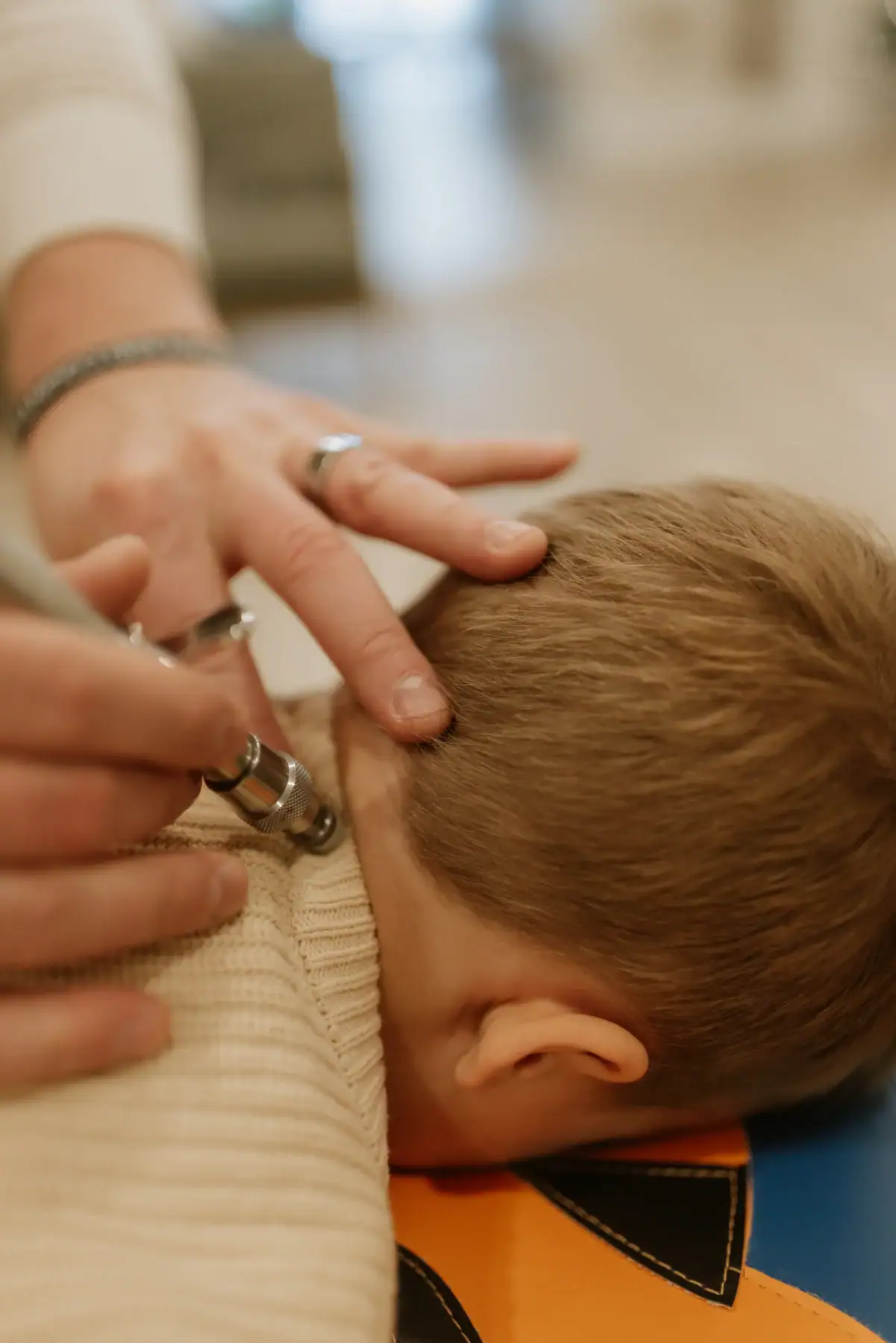
Two things sit underneath the gap. The first is drainage, which comes back to movement. The top vertebrae of the neck sit directly beside the nerves and muscles serving the ears, sinuses, and lymphatics, so a neurologically focused chiropractor checks whether that region moves freely or holds tension. Birth is often where the question starts: induction, forceps, vacuum extraction, and cesarean delivery all place real physical stress on a baby’s head and neck, and that history is worth knowing years later. It’s part of why we talk with new parents about baby chiropractor benefits in the first weeks after delivery, not years down the line.
The second is immune regulation. The brainstem and vagus nerve help govern inflammation and the body’s response to infection, so a child running in a stressed, dysregulated state may have a harder time mounting a balanced response. This is active research rather than settled fact, but for parents asking what causes repeated ear infections in children, it reframes the question. The body isn’t failing. It may simply be stuck.
Dr. Ryan Angelo, DC, has spent more than seven years as a chiropractor in Chesterton, Indiana, and this pattern comes up constantly with families who have already tried the usual routes. Adjusted Living is the only PX Docs-certified pediatric chiropractic office in Chesterton and Porter County, a credential specific to neurologically sensitive and complex children.
Rather than guessing, care starts with INSiGHT scans: heart rate variability, surface EMG, and rolling thermography. Those scans measure how a child’s nervous system functions before we recommend a plan. From there, gentle tonal adjustments support motion in the upper neck and nervous system function, always alongside your pediatrician’s care, never instead of it. Change takes time, so our care plan is built in phases rather than promised in a visit or two.
Practical Ways to Help Prevent Ear Infections in Your Child
Preventing ear infections in toddlers starts with the factors you can control. Steps worth taking now:
- Breastfeed if you’re able. In a federal evidence review summarized by the AAP, exclusive breastfeeding for three to six months was associated with about a 50% lower rate of ear infections compared with exclusive formula feeding
- Keep your child away from secondhand smoke, which irritates the Eustachian tube lining
- Limit pacifier use, especially after about six months
- Keep vaccinations current. Flu vaccination is associated with fewer ear infections during respiratory season, since influenza often precedes a bacterial one
- Build strong handwashing habits for the whole family
- Work with your child’s doctor on seasonal allergies and congestion before they settle in
- Keep babies upright during and after feeding to reduce fluid pooling
For natural remedies for ear infections in children, a warm compress can be comforting, and protecting sleep and nutrition supports natural immune support for kids more broadly. These are supportive strategies, not replacements for medical care when an active infection is present.
If your child keeps cycling through ear infections and you want to understand the pattern behind them, we’d love to meet your family. Read stories from other Porter County families, then request an appointment at our Chesterton, Indiana office. We’ll start with scans and be honest about what nervous system care can and can’t do.
FAQs About Recurring Ear Infections
Why do ear infections keep coming back even after antibiotics?
Antibiotics clear the bacterial infection, but they don’t change why fluid keeps building up or why one child’s immune response struggles more than another’s. Short Eustachian tubes, poor drainage, daycare exposure, allergies, or a dysregulated stress response may all still be in play once the course ends. If infections keep returning, ask your pediatrician about an ENT referral and what else may be driving the pattern.
How many ear infections per year is too many for a child?
Three or more in six months, or four or more within one year, is considered recurrent and warrants evaluation. Specialists typically discuss options like ear tubes at that point. Even two or three close together are worth a conversation with your child’s doctor.
Can ear infections cause permanent hearing loss in children?
Fluid buildup commonly causes temporary hearing loss while it’s present. Less commonly, repeated infections that go unaddressed can lead to longer-term complications. Early evaluation protects hearing and language development, so a recurring pattern shouldn’t be left alone.
Could my child’s birth have something to do with this?
It’s a fair question. Births involving induction, forceps, vacuum extraction, or cesarean delivery place extra physical stress on a baby’s head and neck, and the upper neck shares nerve supply and drainage pathways with the ears and sinuses. Chiropractors trained in pediatric care assess that region directly. It’s one input among several, not a diagnosis, and it doesn’t replace what your pediatrician finds on exam.
Can a chiropractor help with chronic ear infections in children?
Neurologically focused chiropractic care isn’t care for an ear infection itself, and it isn’t a substitute for your pediatrician. It supports motion in the upper neck and the nervous system’s role in regulating immune and inflammatory responses. For a recurring pattern, it’s one piece of a broader approach, best used alongside the medical care your child already receives.
