

Key Takeaways
- Recovery shows up in a predictable order for most people. Sleep and breathing usually shift before emotional steadiness or steady energy does.
- Muscle twitching, unexpected tears, and digestive changes are normal parts of a body letting go of stored stress, not signs something has gone wrong.
- Heart rate variability is one of the few markers you can actually measure, which is why we re-scan instead of relying on how a week felt.
- Progress is rarely a straight line. A hard week after three good ones is part of the pattern, not a reset to zero.
- Your child’s regulation is tied to yours. Kids borrow calm from the adults around them before they can generate it themselves.
The signs your nervous system is healing are usually quiet ones: better sleep, slower breathing, muscles that let go without being told to, and reactions that finally match the size of the problem in front of you. They rarely feel like a breakthrough. Most parents describe them as noticing something missing rather than something new: the bracing that isn’t there anymore, the shoulders that stayed down all morning.
That subtlety is exactly why so many people give up two weeks before things turn. If you recognized the signs of nervous system dysregulation in yourself or your child months ago and have been waiting for evidence that anything is actually shifting, this is what that evidence tends to look like.
How We Know These Signs Are Real
Two things shaped this list. The first is the research on how the autonomic nervous system behaves under sustained stress and how it behaves as that load lifts. The second is what we see in the office in Chesterton, Indiana, when we re-scan a parent or child eight weeks into care and compare it to their first day.
That second part matters. Feelings are unreliable narrators. A mom can tell me she feels “about the same” while her scans show measurably different autonomic function than they did in March. She isn’t wrong about how she feels. She just doesn’t have a before-and-after she can look at.
For context on how common this is: the World Health Organization reports that 359 million people were living with an anxiety disorder in 2021, making it the most common mental disorder worldwide. A large share of those people are running a nervous system that hasn’t been allowed to downshift in years.
11 Signs Your Nervous System Is Healing

1. You’re Sleeping More Deeply and Waking up Rested
When the system is dysregulated, the sympathetic side stays partly online overnight, keeping the body in low-level alert. That fragments deep and REM sleep, which is why you can spend eight hours in bed and wake up wrecked.
As parasympathetic nervous system activation reclaims the night, you fall asleep faster and stay asleep. Vivid, emotionally busy dreams often show up during this stretch. That’s normal. Sleep is where a lot of stored stress gets processed, and better sleep then feeds the next round of recovery. This is the one most parents notice first.
2. Your Breathing Slows and Deepens on Its Own
Shallow, chest-level breathing is a hallmark of a body stuck in fight or flight. Short, frequent breaths keep signaling threat to the brain.
The key word here is automatically. Learning how to reset your nervous system with breathwork is genuinely useful. But noticing that your breathing has already changed, without you managing it, is a different thing entirely. That’s your body making the choice, not you.
3. Muscle Tension Releases, Sometimes Without Warning
Chronic dysregulation keeps muscles in low-grade contraction. The jaw clenches, the shoulders creep up, the hips stay tight. It becomes so familiar that most people stop noticing it.
When the system starts to regulate, that stored tension lets go, sometimes as sudden twitches, brief trembling, a spontaneous deep sigh, or warmth spreading through a muscle group. These are physical signs the body is releasing stored stress, and they’re completely normal.
4. Your Emotional Reactions Become Proportionate

Stuck in threat mode, the nervous system treats small stressors like emergencies. You cry over minor friction, snap without meaning to, or feel nothing at all.
As things settle, responses start matching reality. Frustration still shows up. It just doesn’t hijack the afternoon.
Early on, sudden waves of emotion can feel like backsliding. Usually it’s the opposite. Dr. Zhikui Wei, MD, a neurologist and sleep specialist at Jefferson Health, has discussed how chronic stress reshapes nervous system function, and why learning to recognize your own stress signals is the starting point. When numbness lifts, feeling comes back before the ability to manage it does.
5. Digestion Starts to Normalize
About 80% of the vagus nerve’s fibers are afferent, meaning they carry information from the body up to the brain rather than the other way around, research indexed by the NIH. That constant upstream reporting is a big part of why digestion is so sensitive to what state your nervous system is in.
When dysregulation is running the show, digestion suffers. Bloating, cramping, nausea, and appetite swings are common. As recovery progresses, motility normalizes and appetite steadies.
For a lot of people this is one of the more surprising signs the vagus nerve is coming back online, because they’d filed their stomach issues under a completely separate problem.
6. You Feel Safe in Your Body More Often
What does a regulated nervous system feel like from the inside? Warmth in the chest. Breath that comes easily. Sounds in a busy room that don’t register as threats. Sitting still without it feeling unbearable.
It arrives in small windows at first. A few easy minutes on a walk. An evening without waiting for something to go wrong. Then the windows widen. You notice you haven’t tensed your shoulders all morning, or that a conversation left you feeling better instead of drained.
7. Your Heart Rate Variability Improves
Heart rate variability is the variation in timing between consecutive heartbeats. Higher HRV generally means a more adaptable, resilient system. Lower HRV suggests it’s locked in stress mode.
This is the sign we care about most, because it’s the one you can actually measure. Everything above is subjective. HRV is a number, and it moves. Watching that number trend over weeks gives you something no amount of journaling can.
A multisite clinical study of adults under ongoing chiropractic care, indexed on PubMed, reported sustained HRV improvement over the course of care. It’s one study, and it isn’t a promise about what will happen for you. It’s a reason we bother measuring rather than guessing.
8. Hypervigilance Fades and You Startle Less
Hypervigilance is scanning a room the second you enter it, flinching at sharp sounds, feeling your heart spike when a car honks, finding crowds exhausting because your brain is grading every input for danger.
As this eases, the startle reflex recalibrates. Sounds are less jarring. Public spaces feel less like exposure. Background noise goes back to being background.
People usually catch this one only in hindsight: I used to jump every time someone walked up behind me.
9. Connection Feels Easier and More Rewarding

Polyvagal Theory, developed by neuroscientist Dr. Stephen Porges, describes a social engagement system running through the ventral vagal pathway, governing eye contact, reading faces, voice tone, and the felt sense of safety around other people.
When the system is dysregulated, socializing feels like performance. You leave conversations depleted and need recovery time afterward, even with people you love.
When it starts regulating, connection stops costing so much. Laughter comes easier. Real curiosity about other people comes back. Co-regulation with safe people supports vagal function, which means good relationships aren’t just pleasant, they’re physiologically useful.
10. Your Energy Stabilizes Through the Day
Running stress hormones around the clock is metabolically expensive. It produces erratic cortisol patterns: anxious in the morning, crashing by two, wired at eleven.
As things regulate, cortisol settles into a healthier daily rhythm, higher in the morning and tapering off. Chronic stress recovery symptoms often include exactly this kind of leveling out. You might notice you’re not reaching for a third coffee before noon, or that the afternoon wall doesn’t arrive.
In our experience this shows up later than sleep and breathing do. It’s usually one of the last things to come back.
11. You Can Sit With Discomfort Without Shutting Down
Daniel Siegel, MD, clinical professor of psychiatry at the UCLA School of Medicine, coined the term window of tolerance to describe the zone where you can feel a difficult emotion and still think clearly. A dysregulated system has a narrow window, so small stressors trigger the same response as real danger.
As things improve, that window widens. Traffic without the chest tightening. Critical feedback that doesn’t unravel your sense of self. Anxiety that shows up without the certainty that it will never end.
This is the sign that tends to hold. It’s also the hardest to fake.
For what this has looked like for families here in Porter County, our Stories of Hope page collects it in their words rather than ours.
How Long Does It Take for the Nervous System to Heal?
Honestly? It varies, and anyone giving you a fixed number is guessing. How long the stress ran, what support you have, sleep, nutrition, and whether you’re getting professional help all change the pace.
What is fairly consistent is the order. Sleep and breathing tend to shift first. Emotional steadiness and digestion follow. Widened tolerance, better HRV, and steady energy generally come last. If your sleep has improved but your energy hasn’t, that isn’t stalled progress. That’s the sequence.
Setbacks are part of it. A hard week after three good ones is how nervous systems recover, not evidence that you’re back at the start. Research on neuroplasticity indicates the nervous system retains real capacity to reorganize at any age.
What We Actually Measure in Chesterton
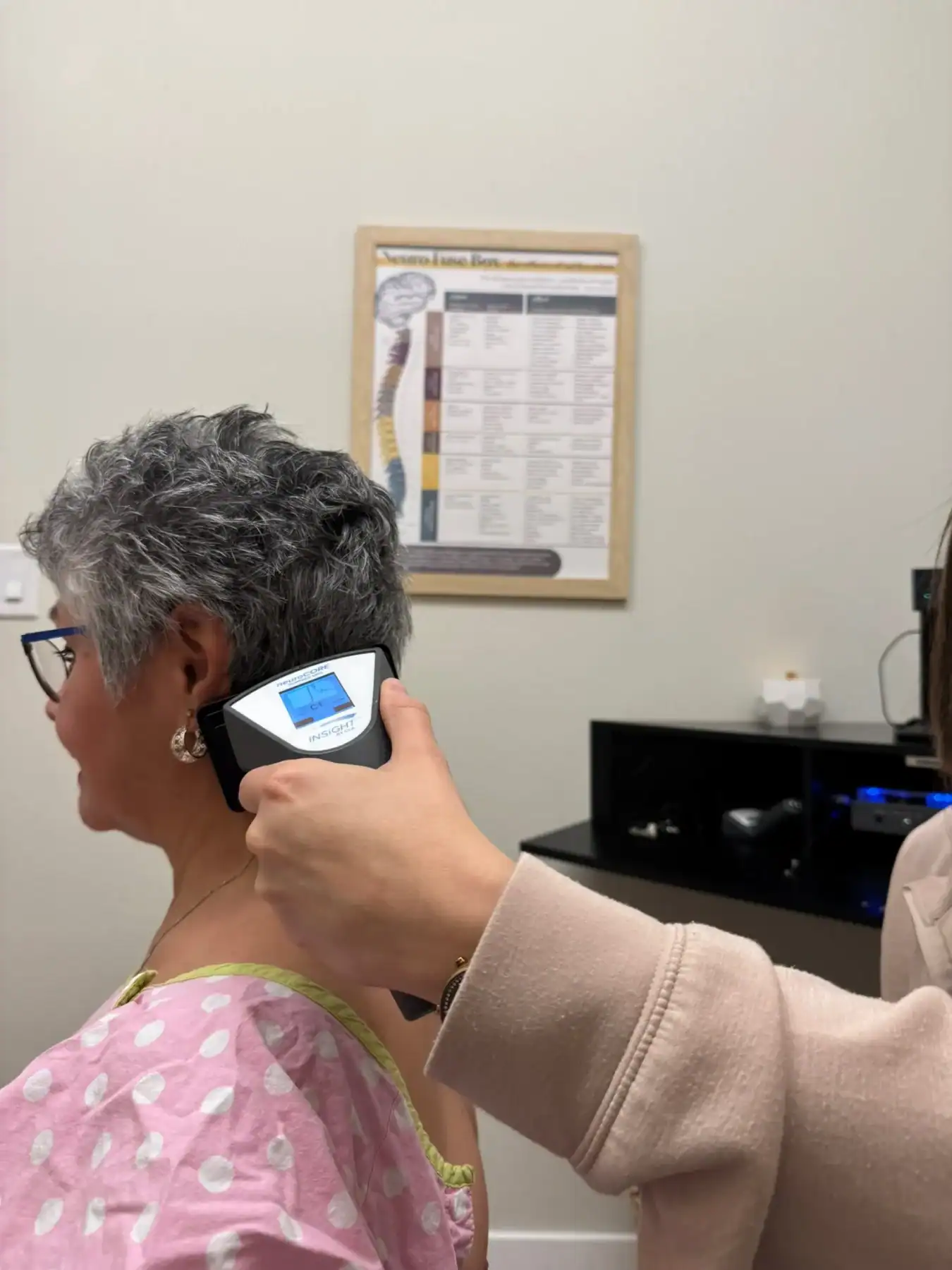
This is where guessing stops. Adjusted Living Chiropractic is a neurologically focused practice, and we’re the only PX Docs-certified pediatric chiropractic office in Chesterton and Porter County. Before we adjust anyone, we run INSiGHT scans: heart rate variability, surface EMG, and rolling thermography. Three non-invasive scans, no radiation, no needles.
- HRV shows how much adaptive reserve you have left.
- Surface EMG maps where muscles are holding tension and how much energy that’s burning.
- Rolling thermography reads how the autonomic system is managing digestion, immune function, and sleep.
Then we re-scan as care progresses. That’s the part that matters for everything above. Instead of asking whether you feel different, we can put your first scan next to your current one and look. Neurologically focused chiropractic care supports the system’s ability to regulate itself; the scans tell us whether it’s working.
We also want to be clear about scope. This works alongside your pediatrician, your counselor, and your occupational or speech therapists. It doesn’t replace any of them, and we’ll say so plainly if what you need is outside what we do.
One more thing worth knowing, and it’s the reason a lot of parents end up here: children borrow regulation from the adults around them before they can produce it themselves. When a parent’s system has more slack in it, the whole house tends to run differently. That’s why we build family care plans rather than treating everyone as separate cases.
FAQs About Nervous System Healing
What are the physical signs your body is releasing stored stress?
Spontaneous muscle twitching or trembling, unexpected crying or laughing, temperature shifts, involuntary sighing, digestive changes, and improved sleep. These happen because the nervous system is finishing stress cycles it couldn’t complete at the time. When the body finally feels safe enough to process what it stored, it finishes the job. The physical response is part of completion, not a sign something is wrong.
What does a dysregulated nervous system feel like?
Often like anxiety with no obvious source, constant threat-scanning, emotional numbness or sudden overreaction, persistent fatigue, digestive discomfort, and poor sleep. Social situations drain you, focus is hard, and real rest feels out of reach even when nothing urgent is happening.
How can I support nervous system recovery at home?
Somatic exercises for nervous system regulation are the most accessible starting point: slow-exhale breathing, intentional shaking, bare feet on the ground, time outside. Consistent sleep timing and safe social contact matter just as much. Nervous system regulation exercises won’t reach everything, though. For dysregulation that has been running for years, professional support tends to move faster than home practices alone.
Can you measure whether your nervous system is actually recovering?
Partly. HRV is measurable and trackable, including on consumer wearables. Surface EMG and thermography require in-office scanning. Most of the other signs on this list are subjective, which is exactly why we pair how you feel with what we can measure.
Ready to Get Some Answers?
If you’re seeing some of these shifts and want to know whether they’re real, or you’re not seeing them yet and want to know why, we can show you your actual numbers rather than asking you to interpret your own week.
Adjusted Living Chiropractic is at 119 Broadway, Suite 1, Chesterton, IN 46304, serving families across Porter County and northwest Indiana.
Request an appointment with a chiropractor in Chesterton, and we’ll start with a consultation and a full set of INSiGHT scans.
